Teyvat Chapter: Season 1

Lore Compendium II
The Four Winds


Breeze Amidst the Forest


A collection of Mondstadt ballads, recorded, compiled, and arranged by scholars centuries ago.
—Ballad Selection Excerpt—
“Breeze Amidst the Forest” and “Breeze Upon the Lake” constitute a two-volume collection of narrative poems. The compilation is the result of the tireless work of scholars who have recorded and arranged countless songs sung by Mondstadt bards.
Bards often elaborate or fabricate history to draw in an audience and earn a few extra Mora. Hence, most of their works have extremely low credibility. What has allowed the songs to remain popular to this day, and to stand the test of the thousand winds of time, is the threads of spectacular imagination and ingenious rhetoric that have been woven into them.
…
“What to be sung hails from ancient times.”
“The gods walked among us in their prime.”
The poet, who had finished recounting the tales of the ruins and Vennessa, began to tell the story of the Wind Dragon. He began to sing, “The story to be told hails from ancient times, when the gods walked among us in their prime.” The dragon graced by Anemo was born* in the high heavens in that age of wonders. He slowly descended, and inspected everything with curious eyes.
He landed in a village, only for the terrified villagers to throw rocks at him. The dragon could not understand why they cried in fear.
He landed in a cemetery, only to hear the lament of grieving people. The dragon could not understand what they murmured in sorrow.
He landed in an orchard, only to be cursed by the furious farmers who lost their trees. The dragon could not understand why they screamed in anger.
The world was too complicated for a young dragon. The dragon was bewildered, yet he did not give up.
One day, the dragon heard music pouring out from the Holy Lyre der Himmel. This was the name of the lyre belonging to the Anemo Archon. Enchanted by the poetry, the Wind Dragon landed beside the best singer under the skies.
People panicked, for the mighty elemental dragons and the great archons that reigned over the earth had never seen eye to eye.
“Behold his beauty and benignity!” The Windborne Bard sang.
“But we do not know him,” the people replied.
What mysterious magic lies behind music and poetry that has the power to mesmerize both dragons and humans alike? I, for one, cannot fathom it. The dragon decided to stay with the bard, for he too wished to be understood by all souls. He learned human speech and Windborne Bard’s singing techniques.
…omitted…
Later generations regarded him as one of the Four Winds that watched over and protected Mondstadt.
“An atrous sun befell its kingdom and a luminous pearl lost its glow.”[Note 1]
“Niveous silk grew dim and wheaten gold burned brilliantly no more.”
So begins another tale that occurred in the lost Khaenri’ah Kingdom.
The Eclipse Dynasty had fallen, and disaster spread across the land. The alchemist known as Gold was corrupted by their own greed and ambition, and created an army of shadowy monsters with their uncanny powers.[Note 2] Durin, a black serpentine dragon, rose from the sea to cast its shadow over Mondstadt. But it was at this very moment that there was no one to inherit the title of Lionfang Knight, thus, the Knights of Favonius could not fly their falcon flag.
The persistent yet despondent prayers called upon the archon of Mondstadt, the Windborne Bard. The strings of the lyre were strummed once more, and the Wind Dragon was summoned forth.
As Mondstadt’s last line of defense, the Wind Dragon battled the wicked dragon to the death in raging storms.
The Wind Dragon prevailed. He tore open the throat of the wicked dragon, at the cost of ingesting its poisonous blood. The blood of the wicked dragon was distorted gold, with the powers to crumble mountains and poison the earth.
The Wind Dragon protected Mondstadt with his life, and his only wish was to be understood by humans. And so, he drifted off into a deep slumber.
The Holy Lyre played a sorrowful tune.
The Holy Lyre sang: should you awaken, spread your wings and live your life freely! A dragon is born to soar the skies, and mortals shall surely grasp your beauty…
(*Typically, when life arises from the elements, it either descends and becomes a slime, or ascends and becomes a crystalfly. Rarely does this process give rise to dangerous elemental monsters. Elemental dragons are rarely seen and have the powers to match the gods of old.)
A supplement to the “Breeze Amidst the Forest” ballad selection with excerpts from various sources.
It tells the story of the Dragon of Mondstadt.
—The Dragon—
An excerpt from “An Investigation into the Cultural Customs of the Wind Kingdom,” more commonly known as “Records of Customs and Culture,” by Jacob Musk.
…
The “Wolf” of the Knight of Boreas, the “Lion” of the Lionfang Knight (or “Dandelion Knight”), the “Falcon” of the Knights of Favonius, and the “Wind Dragon” Dvalin have been long regarded as the Four Winds that watch over Mondstadt.
After the Lionfang Knight liberated Mondstadt, the Knights of Favonius was established, and the Knight of Boreas joined them.
The tradition of worshipping the Four Winds was gradually formed in Mondstadt. However, Dvalin, the ancient Wind Dragon, predated them all.
Approximately one hundred years ago, the land was in chaos. Darkness spread, contaminating everything it touched. Barbarians and foul creatures roamed the lands, forcing people to dwell within the city walls.
It was an especially difficult time for Mondstadt. The Lionfang Knight was without a suitable heir, and the Knights of Favonius had lost many of its brave men and women during the bitter wars. During the most difficult of times, Durin, the corrupted dragon of immeasurable power, began attacking Mondstadt.
The prayers of Mondstadt’s people awoke the Anemo Archon, and his will summoned forth the Wind Dragon Dvalin. As the last defender of Mondstadt, Dvalin battled Durin with all his might.
The result was clear — Durin’s remains still lie atop the snowy peaks to the south of Mondstadt — but the story of how the battle ended was lost in time. It is said that Dvalin ripped out Durin’s throat, and together they fell from the sky. Durin’s body sunk into the snow while Dvalin was summoned by the Anemo Archon and fell into a slumber.
…
People used to believe that Dvalin would awaken whenever Mondstadt faces a new threat.
But in these times of peace, the belief of the Four Winds has gradually eroded and their temples lie all but completely deserted.
(Citation of unknown origin: By the time the Knights finally discovered that the foreign monstrosity named Stormterror, with which they clashed countless times, was in fact Dvalin of the Four Winds, the enmity that had grown between them and driven them to conflict could not be undone. One can scarcely imagine the betrayal Dvalin must have felt when he awoke after a hundred years of slumber only to find that the people of Mondstadt, whom he had protected with his life, had forsaken him…)
Book Location
- Volume 1 can be found in the library of the Knight of Favonius’ HQ
- Volume 2 is given to you by Lisa at the end of Prologue Act I.
Lost in Translation
In volume 1, in the second half of the volume, it’s mentioned how an alchemist called Gold was corrupted by greed and ambition and used uncanny powers. All of this is a translation error. In the original Chinese script, it only states that “Gold became a sinner and gave rise to monsters”, with no mention of greed, ambition or uncanny powers.
About the Timeframe
In volume 2, this book presents an error. It states that 100 years ago, the land was in chaos. This is an error carried over from the old beta lore. The correct timeframe is 500 years ago.
Guide's Note
The first half of Volume 1 focuses on Dvalin’s first encounter with Venti and how he became one of the Four Winds.
The second half mentions Khaenri’ah (previously tackled in Kaeya’s stories), and the battle between Durin and Dvalin, that seems to have put the latter to sleep with its poison.
The disaster mentioned in volume 1 may be presumed to be the same event presented in volume 2, when the land fell in chaos.
East Temple of the Four Winds
Dvalin is the only one of the Four Winds that does not have a temple present in-game, but Diluc does mention the existence of the “East Temple of the Four Winds” during “Prologue: Act II – For a Tomorrow Without Tears”
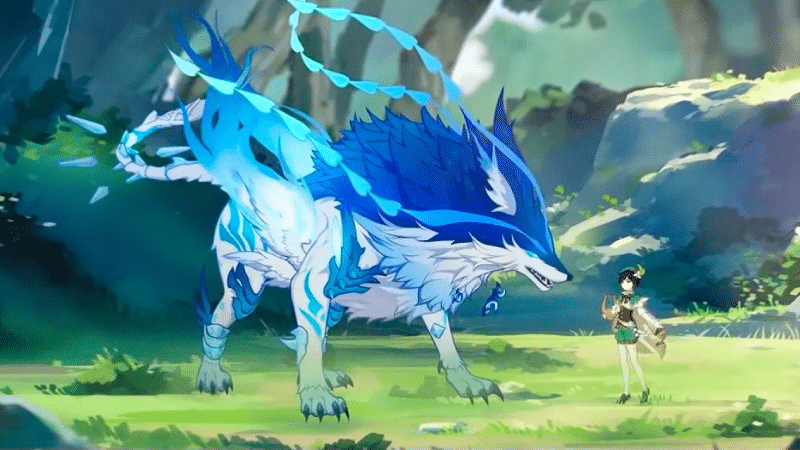
Boreas, as seen in Venti’s Teaser Trailer – “The Four Winds”

Favonius Sword
A standard-issue longsword of the Knights of Favonius. When you’re armed with this agile and sharp weapon, channeling the power of the elements has never been so easy!
A standard longsword wielded by the Knights of Favonius. It is usually issued after the approval of both the Master of the order and the Church.
The craftsmen in Mondstadt have achieved some results in elemental affinity by studying Mondstadt’s Anemo.
This light and agile sword is not only an honor bestowed upon a Knight of Favonius, but also the fruit of the hard work and skills of the guardians of Mondstadt.
It can channel elemental power with ease. Its bearer could do well to remember that its sharp blade is intended for defending, not attacking.
The traditional art of Favonius Bladework was originated by the childhood friend and spiritual counterpart of Arundolyn, the Lion of Light, whose name was Rostam, the Wolf Pup.
Legend says he could chop each drop of rain out of the sky, and that the wind from his sword dance could split the rose and extinguish the torch.
In this lies the essence of Favonius Bladework: light, swift, and precise in the defense of Mondstadt.
At age of twenty-seven, Rostam received the title of Wolf Pup.
Knights of Favonius tradition dictated that the titles of Lion and Wolf were reserved for those of great leadership potential. Such individuals would one day assume the position of Grand Master, devoting themselves to the leadership of a multitude of knights and the safeguarding of Mondstadt.
But though he fulfilled his duties faithfully, and devoted himself to Mondstadt, Rostam would not live to see that day.
Since Rostam introduced the bladework style, no other practitioner has ever matched his legendary ability.
But his fervor, along with his will to protect Mondstadt, have stayed with the knights throughout the generations.
Guide's Note
In honor of two of the Four Winds (Lion and Wolf), certain titles are reserved for those with great leadership potential. This is why Jean The Dandelion Knight is also referred to as the Lionfang Knight.
Last explored in:
Lore Compendium I - Monstadt's Novels
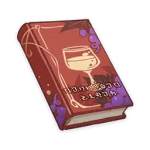
A Drunkard's Tale
Volume 1
One of many popular tales told of Mondstadt’s drinkers. This one is the story of a drunkard who stumbled into wolven territory and the lone, starving wolf he encountered there.
In the land where the dandelion wine flows like a river, tall tales have a way of spreading far and wide, following closely in the wake of the whiff of wine.
Far-fetched fables are always sure to spread when boasted between burps by inebriated bar patrons. For these stories share something in common with the slurred speech and sea-sickness-inducing swaying that so often accompanies them, which is that despite being clumsy and awkward, they are also highly entertaining.
Legend has it that there was once a famous drunkard in Mondstadt. It was said that he could hold his alcohol as well as any hunter from Springvale in the off season. And yet, still he would drink till he was drunk, every time that he drank, he would not budge so much as an inch back from the bar at the tavern until not a single Mora was left in his coin pouch, and not a single drop of wine remained in his glass.
One night, this drunkard was doing his best to stumble home after a particularly satisfying session of especially heavy drinking. A combination of his spinning head, blurred vision, and zigzagging stride served to navigate him towards a forest populated by wolves.
Today, of course, Wolvendom is presided over by the Great Wolf King of the North, and the ominous atmosphere that emanates from inside the forest is sufficient to deter most sober-headed visitors from approaching the area. According to the elderly hunters, the Wolf King gathered the spirits of the wolves there to prevent outsiders from trespassing into territory where they are not welcome.
But this was an age long before the Wolf King and the north wind had descended upon that forest, bringing order and peace to the wolven race. At that time, the forest was a perilous place where wild wolves fought for survival. A fierce blood feud between wolves played out deep inside the dense foliage, concealed from view and unbeknownst to any man.
Least of all to the drunkard, who had by this point managed to transport his drunken self quite some distance inside the forest.
He stumbled forward in the darkness with that dogged determination that only drunkards possess, deterred neither by the tree roots that would trip him up every few steps, nor by the stray branches that would slyly slap him in the face from time to time.
Before long, a pair of green eyes began darting through the forest, their gaze fixed on him, tracking his every move.
Those eyes belonged to a lone wolf, who silently pursued the drunkard from behind, all the while musing to itself:
“This is the most peculiar sight I have ever seen in all my life.”
No one had dared set foot in the wolves’ forest in hundreds of years, be they a knight clad top to toe in shining steel armor or a desperate fugitive dressed in rags. Even the callous nobles refused to exile their slaves there, for fear of inciting the wrath of the wild wolves and bringing unwanted trouble to their own territory.
“And yet, this odd fellow dares to stroll in here all by himself. How very strange indeed!”
The lone wolf pondered this strange phenomenon as it followed the drunken intruder through the forest, doing its best to ignore the stench of alcohol that was wafting its way.
Book Location
-
Volume 1 is located inside the Dawn Winery.
Guide's Note
The Great Wolf King of the North that presides over Wolvendom is presumably Boreas, the Wolf of the North.
Temple of the Wolf

This ruin used to be a temple devoted to the Wolf of the North. Now, the priests are gone, and the temple has been seized by monsters. However, they say that the spirit of the Wolf still watches over the endless fields of Mondstadt from someplace else.
Guide's Notes
Visited during Prologue Act I, the Temple of the Wolf was Boreas’ old residency, before moving to Wolvendom.
Temple of the Lion
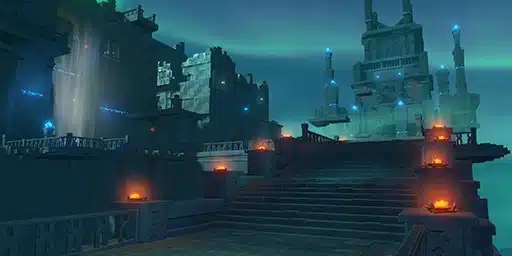
This used to be a temple devoted to the Lion of the South, but it has long been abandoned. Folklore tells that the dandelions commonly seen riding on the winds across Mondstadt symbolize the blessing of the Lion of the South.
Guide's Notes
The reason why the Lionfang Knight is also referred to as the Dandelion Knight is because in Mondstadt it’s believed that dandelions are a blessing of the Lion.
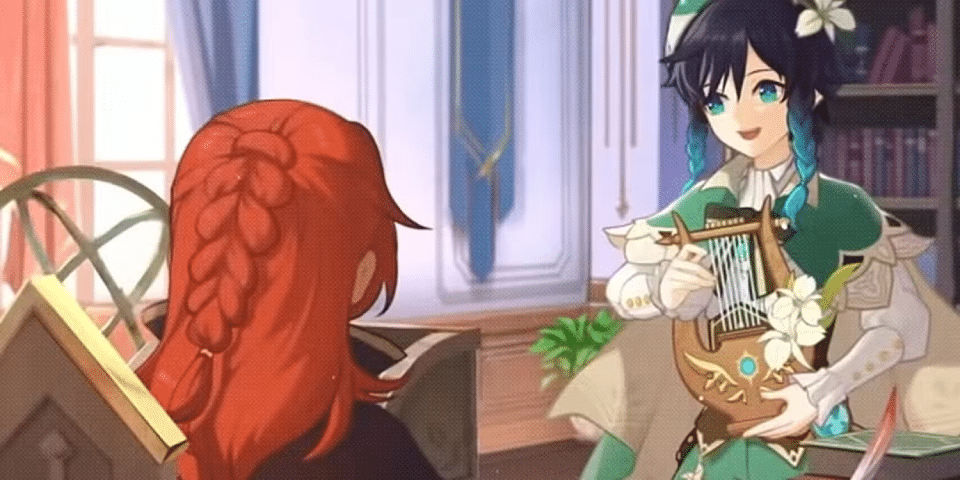
Who is the Falcon of the West? In Venti’s teaser the West is only brought up in relation to a Lionfang Knight. A mystery indeed.